Blog
Private tour vs. group departure: what do you actually get with each?
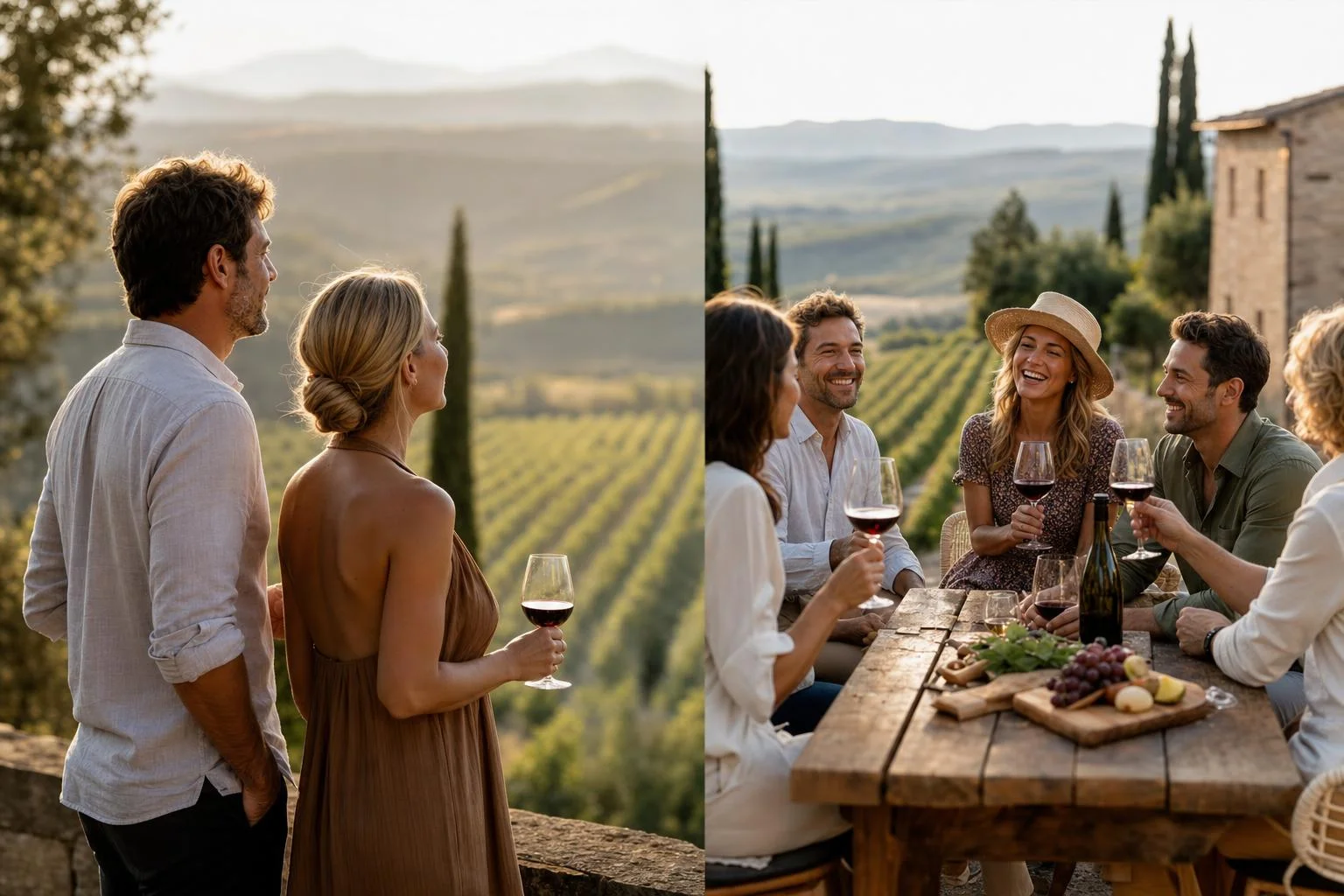
When you begin planning a journey through European wineries and galleries, one of the first questions that arises is neither the destination nor the season — but the format. A private itinerary built from scratch exclusively for you, or a group departure in which you share the experience with several dozen fellow travellers? On paper the difference sounds straightforward, yet in practice that decision touches almost every aspect of the journey: who enters which cellar, how long you spend before a particular canvas, how the tasting unfolds and how deeply the conversation can go. This piece is not intended to crown one format the winner — both have their merits — but to give you enough concrete information to make the right decision for yourself.
How these two models actually work
A group departure operates on the logic of a pre-set programme. Dates are fixed, the route is agreed in advance with partner wineries and galleries, and the guide — whether a sommelier or a curator — adjusts the pace and depth of content to the group's average level of interest. Such departures often attract people who are just discovering the world of wine and contemporary art, as the shared dynamic provides reassurance and companionship. The schedule is known in advance, logistics are taken care of, and the price is typically lower because costs are shared.
A private itinerary works in an entirely different way. It begins with a conversation: what interests you, what pace suits you, do you prefer cellars in the morning or galleries, do you have any allergies that affect tastings, do you enjoy hotel breakfasts or would you rather start with an early visit to the vineyard? Only after that conversation does the building of the programme begin. The dates are yours, the order of visits is yours, and sometimes even the route itself — because trusted relationships with winemakers and curators mean doors can be opened that are simply not available to groups.
It is important to understand that neither format is inherently 'better'. A group departure offers structure and community, while a private itinerary offers autonomy and depth. The right choice depends on what you consider a worthwhile experience.
Schedule flexibility: freedom of movement as the defining difference
On a group departure, the clock is the enemy of every tasting that moves in an interesting direction. The guide has a coach waiting, the next winery booked for a precise time and a responsibility to all the travellers. If the conversation with the winemaker turns towards an old vintage from 1997 or an unusual vinification process that runs to three hours, the guide must draw it to a close — because the programme does not wait. The same principle applies to galleries: a slot of an hour, an hour and a half is allocated, and then — regardless of whether you have paused before a work that has truly captivated you — the group moves on.
A private itinerary carries none of that pressure. If you discover in one cellar that the skin-maceration process fascinates you and you would like to stay another hour, that hour is found — without compromise. The next visit is shifted, or rearranged with the partner winery by phone on the go. This is not improvisation; it is deliberately built-in flexibility that demands an experienced organiser who knows the partners well enough to change the schedule without anyone taking offence or a reservation being lost.
There is also a practical aspect that is often overlooked: the pace of the day. Some people are morning types who like to be in the vineyard at eight; others prefer to start after ten. With children, elderly parents or people with particular needs, a fixed group schedule can become a source of stress rather than pleasure. A private programme simply adapts — not as an exception, but as the starting point.
The depth of the tasting: a conversation that goes beneath the surface
Wine tasting on a group tour necessarily has a didactic character. The guide covers the basics of terroir, describes the grape varieties, leads the group through the sensory protocol — colour, aroma, taste, conclusion. This is invaluable for someone just discovering wine, but for an experienced enthusiast who wants to hear what the winemaker thinks about the impact of climate change on their last three vintages, the group format simply does not allow space for that kind of conversation. There are too many participants, too many different levels of knowledge, and the guide must attend to everyone.
In a private format, that same conversation can last an hour and a half and become a genuine expert discussion. The sommelier accompanying you can adjust in real time what we taste — skipping wines that tell you nothing new and focusing on what truly sparks your curiosity. The winemaker or producer who receives you knows that a smaller, carefully chosen group of guests is arriving, and will often open up in an entirely different way than when thirty tourists with cameras walk into the cellar.
The same logic applies to the gallery component of the journey. A curator accompanying a small private group before a Matisse or a Klimt can develop a narrative that responds precisely to the questions you are asking — can pause, can return, can draw parallels with what you saw the day before in a Tuscan villa. In a group of thirty people, that conversation simply has no room or time to unfold.
Access to exclusive cellars and private collections
One of the least-mentioned yet most significant aspects of private wine-and-art journeys is access that is simply not available through standard group programmes. There are wineries in Istria, Burgundy or the Ribera del Duero that do not accept group visits — not out of snobbery, but because their premises, working philosophy or sheer annual production do not permit high visitor volumes. Those same wineries will open their doors to a smaller group arriving with a personal recommendation through a trusted channel, knowing that these are visitors who understand what they are seeing and what they are witnessing.
The same principle applies to private collections and museums. Many European collectors hold exceptional collections of contemporary or modern art that are not open to the public, yet are accessible through a curated approach — with a curator who has a personal relationship with the collection's owner and can secure a visit that becomes a genuine experience rather than a tourist walk-through. A group departure sold on the open market can almost never offer that kind of access.
To be honest: this exclusive level of access does not come automatically with a private format — it comes from an organiser who has spent years building relationships with specific winemakers, estate owners and curators. That is why, when choosing a private journey, the key question is not only what is on the itinerary, but where those connections come from and how they were built. A credible network of partners is what distinguishes a genuinely private programme from an expensive group tour with fewer seats.
The social dimension: solitude or community?
One of the unexpected advantages of a group departure is precisely its social dimension. Travelling with others who share a similar passion for wine and art can lead to acquaintances that last for years. A shared dinner after a day spent in cellars, exchanging impressions on the coach, spontaneous recommendations between fellow travellers — all of this builds a particular kind of community that the private traveller may find themselves missing. For solo travellers seeking new connections, or young couples who enjoy a lively group atmosphere, a group departure can be exactly the right choice.
The private format, on the other hand, suits couples who want a journey as a deeper shared experience, families with clearly defined interests, business friends combining relaxation with networking, or seasoned individuals who know precisely what they want and have no wish to compromise any aspect of the programme for the sake of a group's average preferences. The intimacy of a private journey also allows for conversations with winemakers and curators that would not unfold naturally in a group setting — the host is more relaxed, more candid, more authentic.
It is worth mentioning a third option that sits somewhere between the two: a small private group of friends or colleagues who commission a private programme together. In this case, you enjoy all the advantages of a private itinerary — flexibility, exclusive access, depth of tasting — while retaining the social energy of travelling together. This is the format that many experienced travellers consider the ideal compromise.
Price and value: what you are actually paying for
A group departure is almost always less expensive per person. The costs of guides, transport, admissions and reservations are shared across a larger number of travellers, which automatically brings the price down. For someone with a limited budget, or for someone who is simply exploring whether wine-and-art journeys suit them, a group departure is a sensible starting point. You receive a structured programme, expert guidance and organised logistics at an accessible price.
A private programme costs more — that is a straightforward fact. But the question is not what it costs; it is what you receive for that difference in price. When you factor in schedule flexibility, access to places that do not feature on standard routes, a sommelier or curator focused exclusively on you, accommodation tailored to your preferences, and logistics that respond to your needs at every moment — the price difference begins to make sense not as a luxury, but as an equivalent of value.
There is also a practical calculation that is often overlooked: the cost of the wrong journey. If you spend a week on a group departure that did not suit your pace, interests or level of knowledge, that is not merely a financial loss — it is a wasted holiday. A well-conceived private programme, shaped around you, reduces the risk of disappointment to almost nothing, because the entire experience is built around your actual expectations rather than the statistical average of a group.
How to make the right decision for yourself
A few questions can quickly clarify which format suits you. How flexible are you with dates? If you have fixed dates and a specific schedule, a group departure can be problematic if it doesn't coincide with your timeframe, whereas a private itinerary starts from your dates. Do you have clear preferences regarding destinations, wine styles, or approaches to art? The more specific your interests, the more useful the private format becomes.
Consider, too, who you are travelling with. A couple celebrating an anniversary, a family with teenagers, a group of business friends — each of these scenarios has entirely different needs that a group departure can rarely satisfy for everyone at once. On the other hand, a solo traveller who wants to discover the world of wine and has no objection to a pre-set programme can have an excellent experience on a well-conceived group departure.
Finally, reflect on your experience. If you are just beginning to explore wine or contemporary art, a group departure with a skilled guide can be an ideal introduction to the subject. If you already know what you are looking for, have experience with wineries and galleries, and want to go deeper — a private programme is the logical next step. It is not a matter of status or price; it is about which format genuinely suits where you are and what you want to bring home.
The decision between a private itinerary and a group departure is ultimately a personal one — it depends on your pace, your interests, your companions, and what a good journey means to you. What is certain is that no experience carefully conceived and guided by experts who understand both wine and art can be a wrong choice. If this article has helped you clarify what you are looking for — or if new questions have arisen — do get in touch. A conversation about your ideal journey carries no obligation, and it is often precisely that conversation which marks the beginning of the finest trip you have ever taken.
Frequently Asked Questions
Is a private tour always more expensive than a group departure?
Per person — yes, a private programme typically costs more, as the expenses of guides, transport, and organisation are not shared among a larger number of travellers. However, if you are travelling as a small group of friends or as a couple, the difference in total cost may be smaller than you expect, while the value you receive — flexibility, exclusive access, a tailored schedule — is significantly greater.
Can I visit wineries on a private tour that are not open to the public?
In many cases — yes. Wineries that do not accept standard group visits are often accessible through personal recommendation and trusted channels that an experienced organiser has cultivated over years. This is one of the key arguments for the private format: access to places and experiences that are simply not on the standard tourist radar.
For whom is a group departure actually a good option?
A group departure works wonderfully for travellers who are just entering the world of wine and art and want a structured introduction, for solo travellers who journey in search of new acquaintances, or for those with a flexible schedule who can follow pre-set dates. A well-led group departure with an experienced sommelier or curator can be an exceptionally rewarding experience at an accessible price.
How far in advance should a private wine-and-art itinerary be booked?
It is advisable to contact the organiser at least six to eight weeks before your intended journey — particularly for destinations such as Burgundy, Tuscany, or Istria during the summer season, when sought-after cellars and estates are booked well in advance. The more elements that require exclusive access, the more important it is to begin planning as early as possible.
Contact Artvino & Co. with an idea, a question, or your preferred dates — we will craft an itinerary tailored precisely to you, whether you are travelling alone, as a couple, or with a small group of friends.
Request a Quote