Blog
A winery journey with your partner: how to craft an itinerary that suits two different tastes
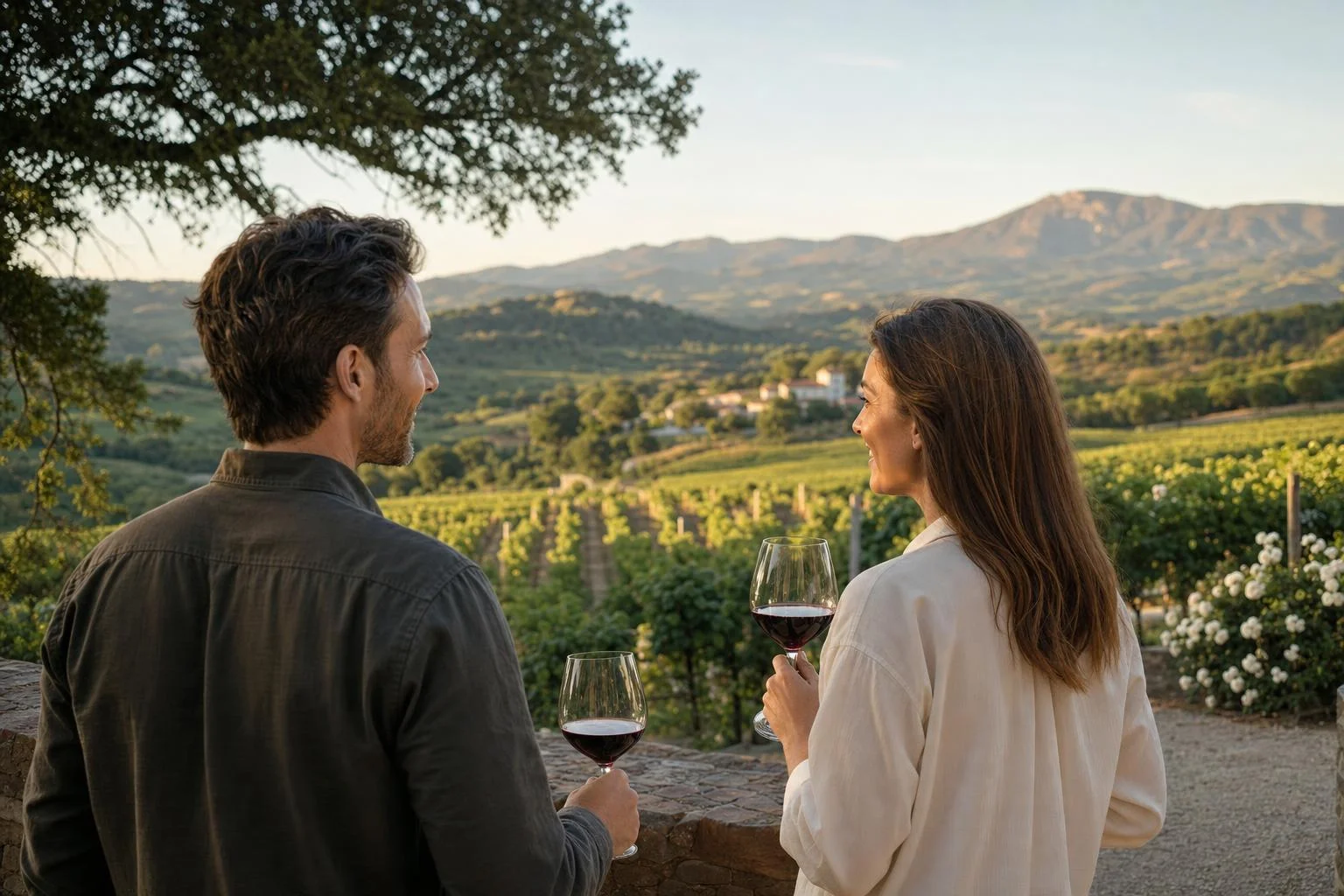
The scenario will be familiar: one of you was scrolling through photographs of Tuscan vineyards and knew immediately — this is it. The other remained unmoved, until they noticed a château converted into a contemporary gallery in the background of that very same photograph. A journey through the wineries and galleries of Europe can be the perfect synthesis of those two worlds — but only if the itinerary is thoughtfully composed. When two different tastes meet without proper preparation, one partner endures lengthy tastings while the other rushes through an exhibition. The good news is that this compromise is entirely unnecessary — there is a way for each of you to have a deep, authentic experience, on the same journey, on the very same day.
Why a difference in tastes need not be an obstacle
When couples begin planning a trip together, the most common pitfall is attempting to divide the itinerary into 'your' days and 'mine'. One day devoted exclusively to wineries, another exclusively to galleries — on paper it sounds fair, but in practice you both come away feeling as though you travelled in parallel rather than together. Shared memories are built from shared moments, not from alternating concessions.
The key insight is that wine and art share the same underlying logic: both speak of terroir, of the people who create them, of a moment in time that will never repeat itself in quite the same way. The vineyard that shaped a particular wine also shaped the landscape that has inspired painters for centuries. When that connection is woven into the itinerary itself — rather than left to chance — the journey becomes a shared story, not a collection of separate episodes.
Experience shows that a partner who is not primarily interested in wine most often does not object to a tasting per se — they object to an empty ritual devoid of context. Equally, a wine lover who says that 'contemporary art doesn't interest them' will often open up entirely before a work that a curator explains through the lens of landscape, fermentation or sensory experience. It all comes down to who tells the story, and how well the itinerary is structured to weave those stories together.
How to make an honest assessment of both partners' interests before you set off
Before you open a map of Europe, it is worth setting aside an hour for a conversation that goes beyond simply agreeing on a destination. Rather than each of you listing what you want to visit, talk about what truly moves you in those experiences — which moments from previous journeys do you still find yourselves recounting. That conversation will often reveal that the wine lover actually values most the intimacy of meeting a winegrower, not the tasting itself. That the partner who favours galleries is really longing for story and context, not necessarily for white walls and silence.
It is worth drawing up a short, informal list of priorities: which experience each of you would call the 'highlight of the journey', and which you would accept as 'lovely, but not essential'. That list is not a contract — it is a tool for the person composing the itinerary. The more information you provide, the more precisely the schedule, pace and choice of locations can be tailored.
It is equally important to be honest about physical and timing preferences. One partner may prefer a slower morning rhythm and long dinners, while the other favours an earlier start and more activities. These seemingly minor differences have an enormous impact on the travel experience — because exhaustion and hunger take no sides in a dispute about the itinerary. A well-considered plan accounts for these 'logistical' emotions, not just the content of the visits.
The architecture of a perfect shared day: morning in the vineyard, afternoon in the gallery
The most effective model for a balanced itinerary for couples with differing interests is not to divide the day, but to layer the order of experiences carefully within a single day. A typical example that works well looks like this: a morning in the vineyard, with a walk among the vines, a conversation with the winemaker and a tasting accompanied by characteristic local produce — all lasting two to three hours. The afternoon is spent at a nearby cultural venue, whether that is a monastic collection, a local museum, a sculpture park or a gallery housed in an old stone palazzo.
The reason this sequence works lies in sensory logic: the morning brings freshness of the senses — the scent of the soil, the colour of the leaves, the coolness of the cellar. By the afternoon, all those experiences have 'settled', and the mind is ready for the visual and intellectual engagement that a gallery offers. The reverse order — gallery first, then vineyard — works equally well, but can be more demanding, as the cellar requires a degree of focus that is harder to achieve if you have already spent three hours on your feet in front of paintings.
In this model, the evening becomes a natural space for synthesis: a shared dinner at a restaurant that works with the winemaker you visited that morning, accompanied by a dish inspired by the local artistic tradition — that moment when two experiences spontaneously converge in conversation at the table is what transforms a journey into a memory. It is no coincidence that couples who travel using this model frequently describe dinner as the 'most beautiful part of the day', even though on paper dinner is neither a vineyard nor a gallery.
The pace and tempo of a visit matter just as much as its content. Half an hour in a vineyard is a flyover; an hour and a half in a gallery becomes fatigue. The optimal duration for an individual visit — both to a winery and to a gallery space — is between 90 minutes and two hours, with an organised break featuring a local drink or a light bite somewhere in the middle. Within that framework, the partner who is less interested in the specific content does not feel trapped, while the one who is genuinely passionate receives sufficient depth.
Specific examples of destinations where wine and art intertwine naturally
Istria is an almost textbook example of a destination where both interests are equally well served. The peninsula has one of the densest concentrations of winemakers with a story to tell — from malvasia that carries the character of stony clay to teran grown on red terra rossa — yet at the same time offers fifteenth-century church frescoes that hold their own alongside contemporary private galleries in repurposed Istrian stone houses. A single day in the Motovun area can encompass a morning visit to a winery with an organic approach to viticulture, lunch at a konoba whose walls are covered in local graphic posters, and an afternoon tour of a fortress with a curator interpreting the visual language of Renaissance fortifications.
Tuscany offers a similar but grander scale. The Chianti Classico zone lies at the heart of not only a winemaking heritage but also a landscape that served as backdrop to Leonardo, Michelangelo, and generations of Grand Tour painters. Winery visits in this region carry a natural narrative thread that connects them to the figurative tradition — the amber colour in the glass answers, almost wryly, the colour of the cypress trees on the horizon. Galleries in Siena or San Gimignano are never far away, and the combination of the Chianti region and the Gothic art of one of those towns makes for a satisfying two-day itinerary.
Burgundy, meanwhile, is an example where the architecture is itself a gallery experience: the Hospices de Beaune, the Romanesque abbeys of Cîteaux and Cluny, and the labyrinth of stone cellars beneath Nuits and Beaune — all of this creates an ambient backdrop in which neither the passionate wine lover nor the passionate art lover can remain indifferent. Destinations such as Burgundy illustrate precisely why a well-conceived journey is not a compromise: it is a union that is richer than the sum of its parts.
Croatia also offers lesser-known yet profoundly impressive combinations — the Pelješac winemaking tradition of plavac mali and dingač, accompanied by the Renaissance walls of Ston and the small but carefully curated museum of sacred heritage in Orebić, is one such example. Krk and the wider Kvarner area bring together continental and Mediterranean wine culture with a rich Romanesque and pre-Romanesque heritage that remains far removed from mass tourism. It is precisely this untouched quality that lends these destinations a degree of intimacy that is beyond price for couples who wish to travel, rather than to be processed as tourists.
The role of the guide: how the right expert keeps both partners engaged
One of the most common reasons why combined wine-and-art journeys fall short is an ill-matched guide. A sommelier who knows nothing of the visual arts will speak to only one partner. An art historian who looks at wine and sees nothing but alcohol will miss the other half of the journey. The guide who works for couples with differing interests is someone who can — and who genuinely enjoys — moving between those two worlds; someone who sees a winery as a cultural artefact and a gallery as a sensory experience.
In practice, this means that a guide should know how to ask questions that engage both partners at the same time. When you are standing before a notable plavac, the right question is not simply 'what do you feel on the palate?' — but also 'do you see how this colour answers the colour of the rocks behind us? That geology is precisely what enters this wine.' This shift in perspective opens the conversation to a partner who experiences wine visually and intellectually rather than primarily through taste. Similarly, in a gallery — 'why do you think this painter was so drawn to this landscape?' — is a question that invites the wine lover, who knows that landscape from the outside, to step inside it.
A good travel organiser knows when to let each partner find their own pace — five minutes alone with a painting, or five minutes alone with a winemaker and a glass whilst a partner browses the labels — and when to bring the experience together. That rhythm between shared and personal space is one of the hardest elements to achieve when planning solo, and one of the easiest when there is an experienced team behind the journey who know both the people on the ground and the dynamics of small private trips.
Practical planning advice: what to decide yourselves and what to leave to the experts
There is a clear list of things couples need to define themselves before the itinerary is drawn up: preferred destinations or regions, an approximate number of days, a preferred pace (relaxed or dynamic), any dietary or mobility requirements, and — often most importantly — what neither of you would wish to do even with a good story attached. That list should be passed to the organiser as early as possible, because fewer adjustments before departure means less stress and a better experience.
On the other hand, there are a number of details best left to the experts: the selection of specific wineries and galleries within the desired region, the order of visits, reservations and negotiations with winemakers and curators, transport between locations, and the choice of restaurants that complement the programme thematically. It is precisely those details — which at first appear merely technical — that actually determine whether a journey will be good or exceptional. Winemakers who receive only a small number of visitors do not advertise online. Gallerists who will give you a private tour with a personal narrative require a recommendation and a trusted connection. Those connections are not built by searching the internet — they are built through years of work in the field.
The budget for this kind of journey is worth approaching with flexibility. More expensive is not always better, but chronically underestimating costs leads to cuts in exactly the places where they hurt most — on the guide, on the time spent at each location, on the choice of accommodation that is truly part of the experience. Saving on a winery means receiving a group tour instead of a private conversation with the winemaker. Saving on a curator means receiving an audio guide instead of a living interpretation. For a journey that aspires to be an experience rather than a checklist, that distinction is essential.
How to tell whether an itinerary is truly balanced — and how to check
There is a simple test you can apply to any proposed itinerary: ask the organiser to say in one sentence, for each element of the programme, what the partner who initially requested it less will take away from that experience. If there is no clear answer to that question, the programme is not balanced — one of you will receive considerably less than what you came looking for.
A good indicator of balance is also that neither of you, looking at the final programme, has the feeling of having 'won'. Instead, you should both have a sense of mild curiosity and anticipation about the elements of the programme that are primarily your partner's domain. That feeling — 'I am not sure what awaits me there, but I can hardly wait' — is a signal that the story has been woven together well.
At the end of a journey, a reliable measure of its success is the conversation you carry home — in the car or on the plane. If you find yourselves recounting the same scenes — the same vineyard, the same encounter with a curator, the same dinner — from two different perspectives that complement each other, the journey has succeeded. If you are telling parallel stories that barely touch, something went wrong in the planning. The good news is that this kind of mistake is easily avoided — with the right combination of an honest conversation with your partner and an experienced organiser who knows how to translate those conversations into days.
Travelling through the wineries and galleries of Europe need not be a terrain of mutual concessions — it can be quite the opposite: an experience in which each of you receives more than expected, because your partner brought a perspective you would not have found on your own. Artvino & Co. builds itineraries that begin from that premise: that wine and art are two languages of the same story, and that every couple deserves a journey in which both voices are heard equally. If you have an idea, a destination in mind, or simply a feeling that somewhere in Europe there is a journey waiting for the two of you — get in touch.
Frequently asked questions
What if one partner does not drink wine at all — does a winery journey still make sense?
Absolutely. Winery visits are, above all, sensory and cultural experiences — the architecture of the cellar, the story of the winemaker, the landscape, the gastronomic context. Many guests who do not consume alcohol describe winery visits as some of the most memorable experiences of a journey, precisely because the depth of the story is independent of the glass in hand.
How many visits per day is realistic within a combined wine-and-art itinerary?
The optimum is two to three meaningful visits per day — for instance, one winery and one gallery or cultural site, connected by a shared meal that ties them together thematically. More than that tips into fatigue, while fewer can leave a sense of insufficient fulfilment. The pace is, however, individual and always adapted to the preferences of the couple.
How do private journeys for couples differ from small group tours?
In a private programme for a couple, the pace, order and depth of each visit are tailored exclusively to you. There is no waiting, no compromising with strangers, and the guide can at any moment deepen or accelerate a part of the programme in response to your reactions. Group tours offer a fixed schedule that may suit an average profile, but rarely fits a specific couple perfectly.
Can we see a proposed itinerary in advance and request changes?
Yes — that is a standard part of the process. Following an initial conversation about your interests and preferences, you receive a proposed itinerary that you are welcome to comment on and adjust. You confirm the final programme only once you are both satisfied with every element.
Share your interests and preferred dates with us — we will craft an itinerary that offers both of you a deep, authentic experience, without compromise on either side.
Request a tailored itinerary